



Banko ceramics quickly develop a patina and become more glossy with use. Fingerprints may be noticeable during the first few months of use, but these will fade as the surface deepens in character. When cleaning, hand-wash with warm water only and a soft cloth, then leave to air dry naturally. Do not use detergents or put in the dishwasher. Hard water may cause limescale deposits to develop, in which case rinse with soft bottled water, then wipe with a soft cloth.
Hohin Banko
Daiya
Iroku
SKU
0560
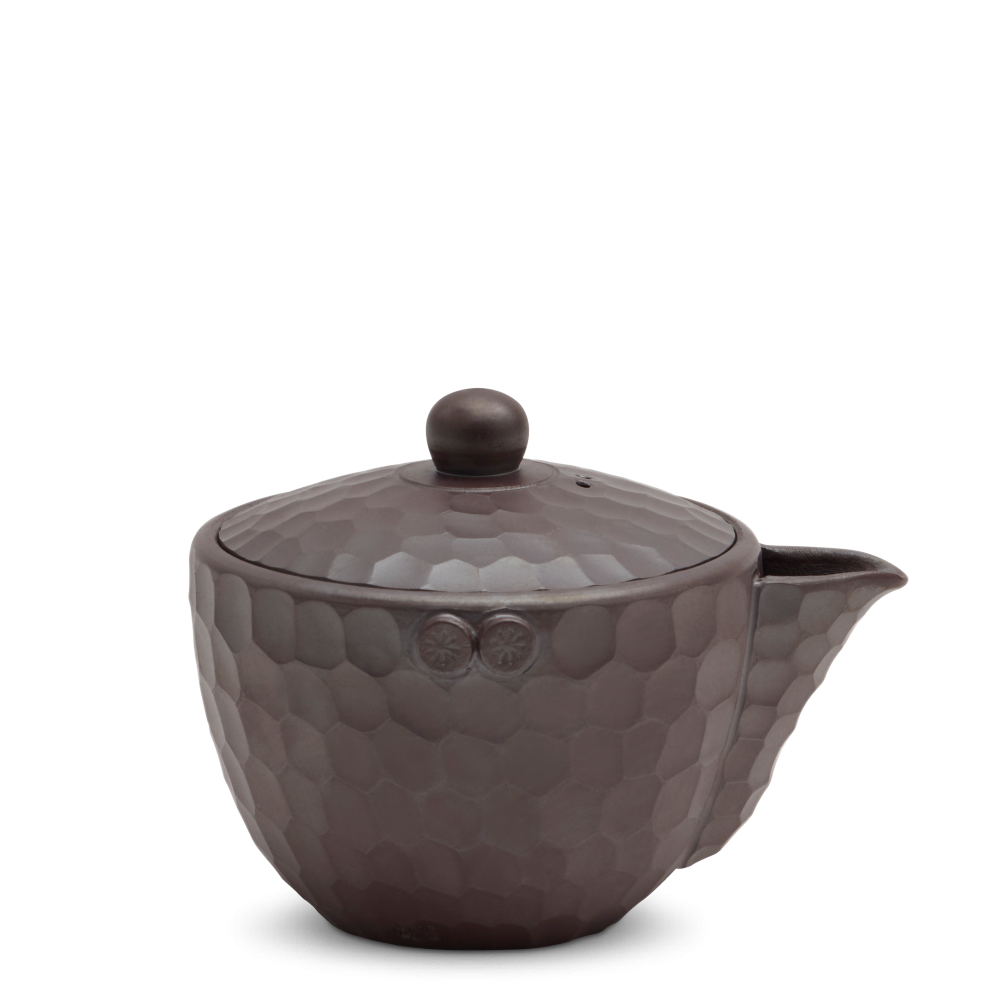
Handleless Hohin teapot made from unglazed Banko clay, with a large spout and strainer for easy pouring. Handcrafted by the certified Traditional Craftsman and fourth generation potter, Iroku, this robust Hohin is adorned in the kiln's signature Daiya ("diamond") cut. Pair with fine Japanese green teas, such as Sencha and Gyokuro.
| Item | Hohin teapot |
|---|---|
| Maker | Iroku |
| Style | Banko-yaki |
| Origin | Yokkaichi, Mie, Japan |
| Volume | 150–175ml (see note) |
| Dimensions | Ø8.5 x 6.5cm (approx.) |
| Material | Unglazed purple clay |
| Strainer | Ceramic filter |
| Artist's mark | Seal to base |
| Packaging | Signed wooden box (Tomobako) |
Each item is handmade and unique therefore measurements vary. Please find further notes on volume at the end of the page.
In stock
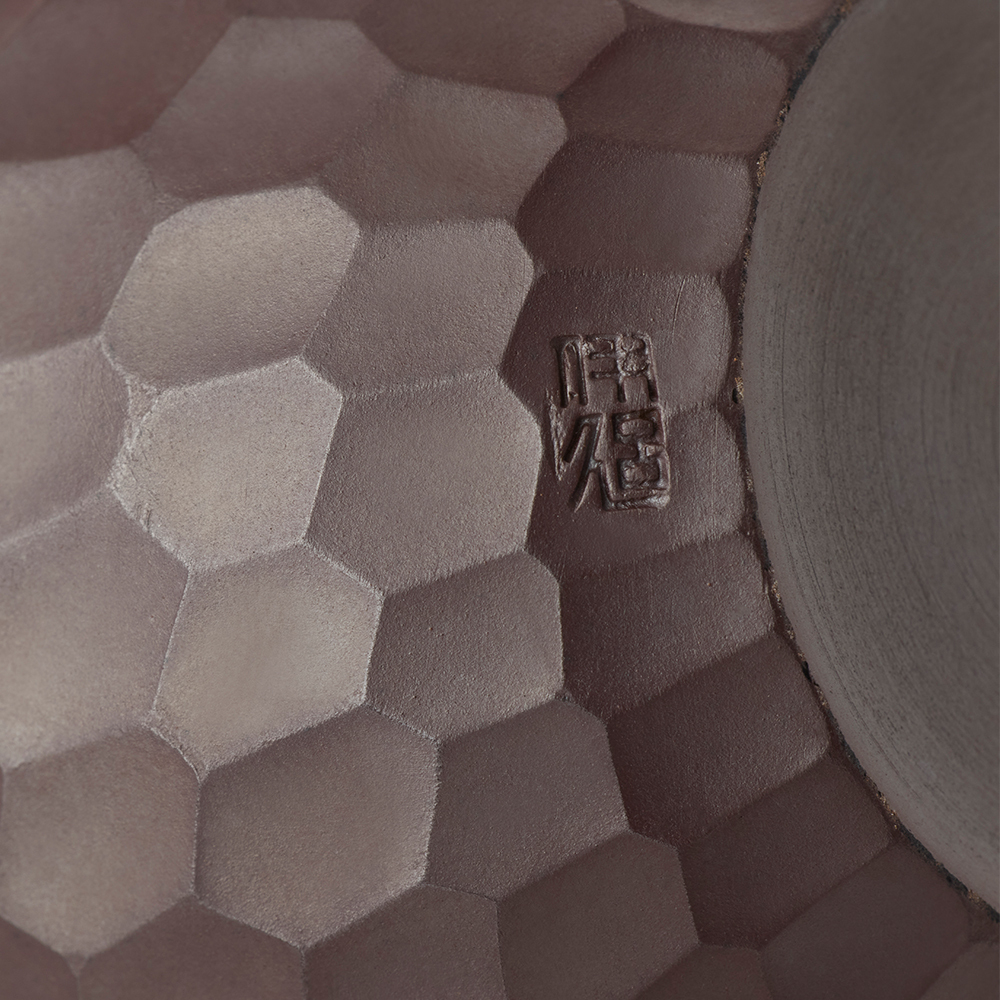
Iroku 伊呂久
Founded in Yokkaichi in 1880 during the mid-Meiji era, the Iroku kiln is now helmed by the fourth generation Iroku Mori, who like his Father before him, is an award-winning, certified Traditional Craftsman. From the beginning, the kiln has endeavoured to make novel and playful Banko Kyusu that are both fun to look at and use. Decorative techniques therefore have long been their forte, notably the traditional Matsukawa “pine bark” pattern applied while the Kyusu body turns on the potter’s wheel, and their signature Daiya "diamond" cut. Perfected over three generations, this geometric pattern is carved into the surface by hand – a laborious task that can take half a day to cover a single Kyusu. The brilliance of these diamond cut masterpieces make them highly collectible items and are an absolute gem of Yokkaichi Banko.
Hōhin 宝瓶
Written in the kanji as “treasure jar,” the Hohin, as its name implies, is used to brew the finest Japanese teas, and is the connoisseurs' vessel of choice for preparing Gyokuro or Kabusecha. Like a Kyusu teapot without a handle, it is a descendant of the Chinese Gaiwan, and cousin to the flatter Shiboridashi. However, like Kyusu, the Hohin has a spout, typically incorporated with a strainer. Hohin are often made of fine porcelain, which means they lose heat quickly, making them perfect for brewing and re-steeping small quantities of delicate high-grade teas that require a lower temperature. For this reason, the Hohin can be handled without a handle.
Banko Yaki 萬古焼
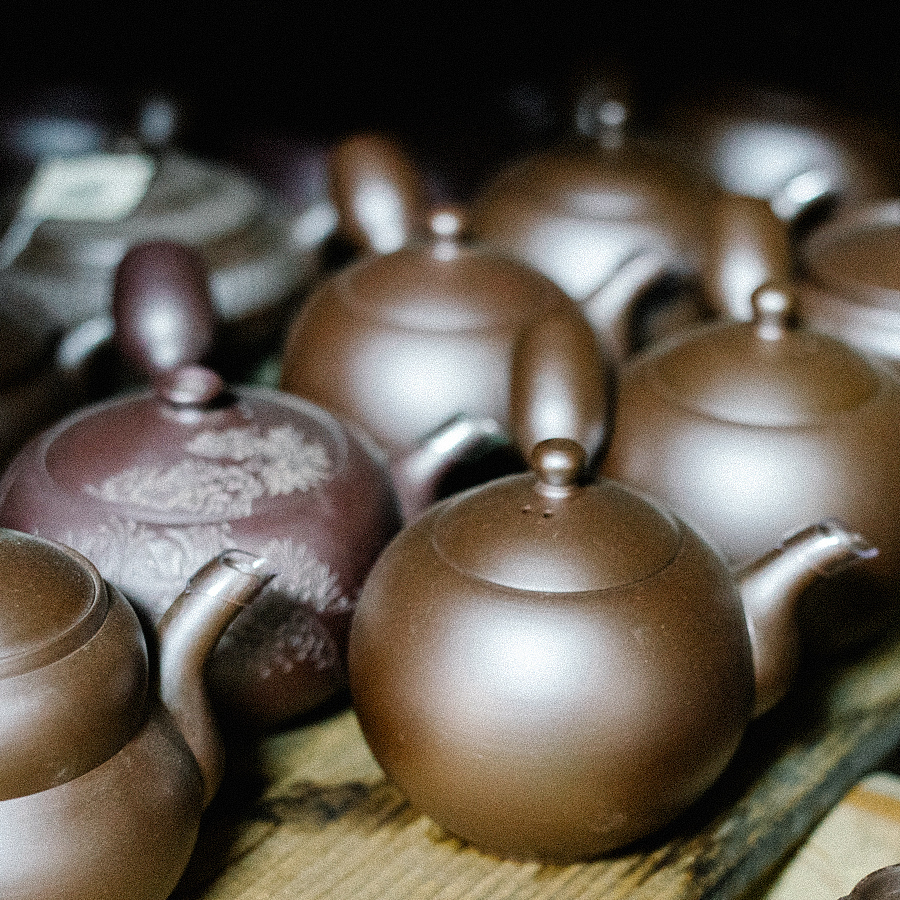
Merchant and passionate Chajin (“tea person”) Nunami Rozan is credited as the founding father of Banko-yaki. Back in the 18th century he opened a kiln in what is now Asahi-machi, Mie prefecture, stamping his wares with 萬古不易 – banko-fueki : “eternally unchanging” – in the hope that his ceramics would be passed down across generations forever. Today Banko-yaki is still produced in the Mie prefecture, primarily in the city of Yokkaichi, and is a protected traditional craft of Japan. Synonymous with Banko is the local, iron-rich Shidei "purple clay", which when baked in a high-temperature reduction furnace becomes very heat resistant and turns the characteristic deep violet-brown of Banko-yaki, with an almost metallic sheen. It is said that the tannins in green tea react with the iron in unglazed shidei teaware to soften the astringency of the tea, highlighting its sweetness; therefore umami-rich teas such as Sencha, Kabusecha and Gyokuro come highly recommended when using Banko.
Our recommendations

-
-
SENCHA 95 P. | MATCHA-IRI 96 P.
Kirishima, Kagoshima
€16.90100g
€169.00 / 1kg
Super Premium 97 P.
Tanegashima, Kagoshima
€19.9080g
€248.75 / 1kg